
.jpg)
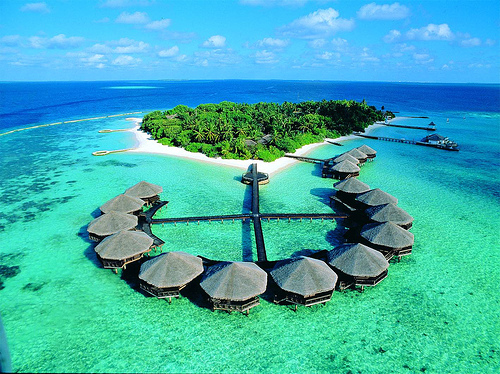
The Maldives consists of approximately 1,190 coral islands grouped in a double chain of 26 atolls along the north-south direction, spread over roughly 90,000 square kilometres, making this one of the most dispersed countries in the world. The atolls are live coral reefs and sand bars, situated on top of a submarine ridge 960 kilometres long. The Maldives is the lowest country in the world, with a maximum natural ground level of only 2.3 metres, with the average being only 1.5 metres above sea level, although in areas where construction exists, this has been increased to several metres. More than 80 per cent of the country's land, composed of coral islands, is less than one metre above sea level.
The reef is composed of coral debris and living coral. This acts as a natural barrier against the sea, forming lagoons. The barrier reefs of the islands protect them from the storms and high waves of the Indian Ocean.
A layer of humus 15 centimetres thick forms the top layer of soil on the islands. Below the humus layer are 60 centimetres of sandstone, followed by sand and then fresh water. Due to high levels of salt in the soil near the beach, vegetation is limited there to a few plants such as shrubs, flowering plants, and small hedges. In the interior of the island, more vegetation such as mangrove and banyan grow. Coconut palms, the national tree, are able to grow almost everywhere on the islands and are integral to the lifestyle of the population.
The limited vegetation and land wildlife is made up for by the amazing marine life. The waters around the Maldives are abundant in rare species of biological and commercial value, with tuna fisheries being traditionally one of the main commercial resources of the country. The Maldives have an amazing diversity of sea life, with corals and over 2,000 species of fish, ranging from reef fish to reef sharks, moray eels, and a wide variety of rays: Manta rays; Stingray; and Eagle ray. The Maldivian waters are also home for the whale shark.
The weather in the Maldives is affected by the large landmass of South Asia to the north. The presence of this landmass causes differential heating of land and water. These factors set off a rush of moisture-rich air from the Indian Ocean over South Asia, resulting in the southwest monsoon. Two seasons dominate Maldives' weather: the dry season associated with the winter northeastern monsoon and the rainy season which brings strong winds and storms. The shift from the moist southwest monsoon to the dry northeast monsoon occurs during April and May. During this period, the northeast winds contribute to the formation of the northeast monsoon, which reaches Maldives in the beginning of June and lasts until the end of August. However, the weather patterns of Maldives do not always conform to the monsoon patterns of South Asia. The annual rainfall averages 2,540 millimetres in the north and 3,810 millimetres in the south.
The Maldives is to become the world's first carbon-neutral country Over the last century, sea levels have risen about 20 centimetres; further rises of the ocean could threaten the existence of Maldives, being the lowest country in the world. On 22 April 2008, then Maldives President Maumoon Abdul Gayoom pleaded for a cut in global greenhouse gas emissions, warning that rising sea levels could submerge the island nation of the Maldives.
The reality of Global Warming hit me while I was researching the Maldives. It has made me realise just how big a problem it is, and what a devastating effect it could have. I hope the Maldives will still be here so I can visit some day, as they are truly beautiful islands.

